

Have you been reading organisations all your working life? Wondering about the gap you notice between formal explanations or plans and what you see actually going on? The meetings that continuously skirt around the issues, the failure of well-planned change, or the one person who seems to hold more stress or anxiety than others? Many skilled practitioners in organisational, team, and system development begin in this way: with curiosity about the puzzling patterns they notice but that may go unnoticed by others, or are downplayed as personal peccadillos, team weaknesses, or flaws in the design of structure or intervention. What more, or what else, is going on here, they ask.
Reading organisations goes well beyond being familiar with the structure, understanding organisational policies and processes or being able to link tasks and outputs to an organisational strategy. It means noticing the apparently unnoticed, being curious about the instances where responsibility becomes unclear or authority is abdicated, curtailed, or ignored. It may mean being curious about the difference between power and authority in the workplace and the ways they are used and confused, effectively interwoven or bluntly wielded. By ‘reading organisations’, I am not suggesting that being clever at spotting flaws in others is useful or valuable, or that being able to identify ‘the truth’ is what is needed. I am suggesting that curiosity about puzzling patterns or inconsistencies, and what these things might mean, provide valuable prompts for inquiry into organisational reality. What might a pattern of behaviour, of decision making, or avoidance, be pointing to? Might these patterns be doing something for the organisation (even when they seem counter-productive)? Your curiosity and noticing becomes valuable information about the workplace.
Supporting curiosity takes it beyond noticing patterns and anomalies and building a bank of observations, it becomes a resource and those with it become masterful staff, managers, leaders, and thinkers. In the first instance, supporting curiosity may simply mean that observations are seen not as ‘facts’ in and of themselves, but as indicators of something broader. This team refuses to speak about the elephant in the room! Might become: what can I see that might be contributing to the elephant being invisible or unspeakable? Curiosity has become the beginning of high-quality, valuable inquiry.
This is where theory becomes useful, for as Kurt Lewin made famous, there is nothing as practical as a good theory (Lewin 1943). With theory the ability to conceptualise grows, with greater conceptual abilities we also learn not only to see more but to also to be able to think in systemic and complex ways. In my experience, systems psychodynamic theory breathes life into experience. Previously unrecognised, or confusing, detail becomes available for thinking as the question above – what can I see… - expands beyond the immediate interaction, room, or structural, curiosity, to include the broader organisation, system, and social context surrounding and interacting with the initial focal point of our curiosity or, let’s be honest, frustration.
Curiosity also turns inwards with the help of theory. What is being provoked in me in this situation and is it offering relevant information? Further, we become able to think with and about the emotions evident in the teams and systems we are engaged with and what unspoken issues or problems they might be pointing to. Theory helps us see both deeper and broader and supports the creation of alternative understandings. This does not mean shopping around for ‘the right answer’, it means we see and work with complexity and have greater skills interrogating our experiences. No longer is the first thing noticed – the team refuses to speak to the elephant in the room – the only thing that is noticed. Workers, managers, leaders, can see, hold, and work with the increased complexity of a situation and, often, with several equally plausible and competing hypotheses before taking action.
Action may simply be better questions, from ‘Why won’t this team talk about X?’ to ‘how does this team feel about X? ‘Why’ questions, enticing as they may be, can often close exploration down as they can invite closed answers and versions of ‘the truth’, or encourage simplicity of understanding, fault and blame, for example. A different question will approach the issue from a different angle, expose a different view, curtail closure of conversation.
The language we use, including the types of questions we ask of ourselves and the organisations we are involved with, is important. It is through language that experience and observation become thinkable and discussable. Expanding the language allows us to move from ‘this team will not speak to the elephant in the room’ to ‘I notice when this issue is raised, the conversation moves on quickly, I wonder what makes it difficult for the team to stay with it’? Private query or unease turns to shareable account that can be worked with. Intentional use of language can help sensemaking and understanding emerge within uncertainty and continuous change.
Working on our sensemaking skills and habits includes the formation of hypotheses that are flexible and work with dynamic situations rather than rush to concrete opinion and simple solution. The working hypothesis is ‘a sketch of reality of a situation’ (Lawrence 1999), an approximation always able to be refined or replaced. The working hypothesis represents a way of working, it is about learning to take what you are noticing and slowing down, investigating, uncovering new material, thinking and developing understanding with it. We then have the grounds for proposing, testing, and taking action with, hypotheses supported by deep thinking and engagement with a breadth of material.
Intervening in the organisation as a decision maker (we all make decisions), manager, leader, coach, or consultant, does not mean building to some sort of heroic moment, finding and delivering the right solution. It may lead to some sort of significant change, however, it is equally, perhaps more, likely to lead to interventions that do not garner much attention at all. You become better able to see and speak to the interconnectedness of the system you are working in. You become better able to prepare thoughtful interventions posing incisive questions opening-up the conversation rather than making provocative statements. You take up authority in your role more effectively, recognising its limits and working constructively with the authority of others. Leading with a clearer understanding of personal skill and commitment, organisational expectation and need, and influence from the broader context.
Through this work, you develop a more disciplined capacity to act in the role you hold. You become better able to understand how personal experience, group dynamics and organisational conditions interact; to remain thoughtful amid uncertainty and change; and to bring difficult patterns into view without reducing them to simple causes or individual fault. You learn to exercise authority with greater judgement: knowing when to question, when to slow things down, when to act, and how to continue thinking under pressure.
Over time, curiosity about puzzling organisational patterns can develop into a disciplined systems psychodynamic practice. Theory, language, experience and reflection help turn initial observations into hypotheses that can be tested, and into more considered action. This capacity can be brought to work from many roles, as a team member, leader, board member, consultant or coach, and across different kinds of organisations. It helps people bring difficult patterns into thought, work with anxiety and uncertainty, and act more thoughtfully.
NIODA’s Master of Leadership and Management (Organisation Dynamics) is designed for people who want to develop this way of working over time. Through theory, experience, reflection and practice, it offers a rigorous learning environment in which curiosity about organisational life can become a more disciplined capacity to understand and work within complexity.
Related insights
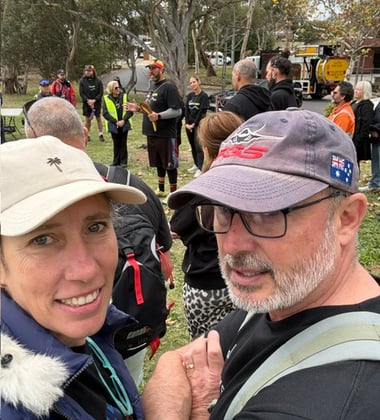
Walking Together: Reflections from the Walk for Truth
A wet Canberra morning at the Walk for Truth sparked a question: could walking together transform how teams connect, converse and reflect?

Slow Down to Lead: The Reflective Edge in Leadership and Management
Most leaders know something important is being lost in the pace of modern work. The capacity to think clearly, read the room, and lead with genuine presence gets crowded out by meetings, deliverables, and the pressure to always appear in control. Slow Down to Lead explores the reflective edge in leadership — what it means to pause without stopping, why emotion is data not distraction, and how developing a reflective practice changes not just how you lead, but how you see.

This course finds people. Perhaps it has found you.
On what it means to study the experience of work, and why that matters more than ever.